Personal responsibility
Teacher and student share responsibility. The teacher guides and corrects; the student must engage honestly and take ownership of progress.
About Fox Valley Budō Kai
The new South Elgin dojo grows from more than three decades of Bujinkan training, years of study in Japan, and sustained experience teaching traditional Japanese martial arts.
Early training
Robert J. Hartung III began training in the Bujinkan in 1993 at age sixteen. His early study centered on the Ten Chi Jin Ryaku no Maki, together with weapons training and the fundamentals of taijutsu.
During his college years, Hartung helped run a small training group, taught several days each week, and continued regular study. Seminars and training with a wider community of American instructors helped shape his decision to pursue the art in Japan.
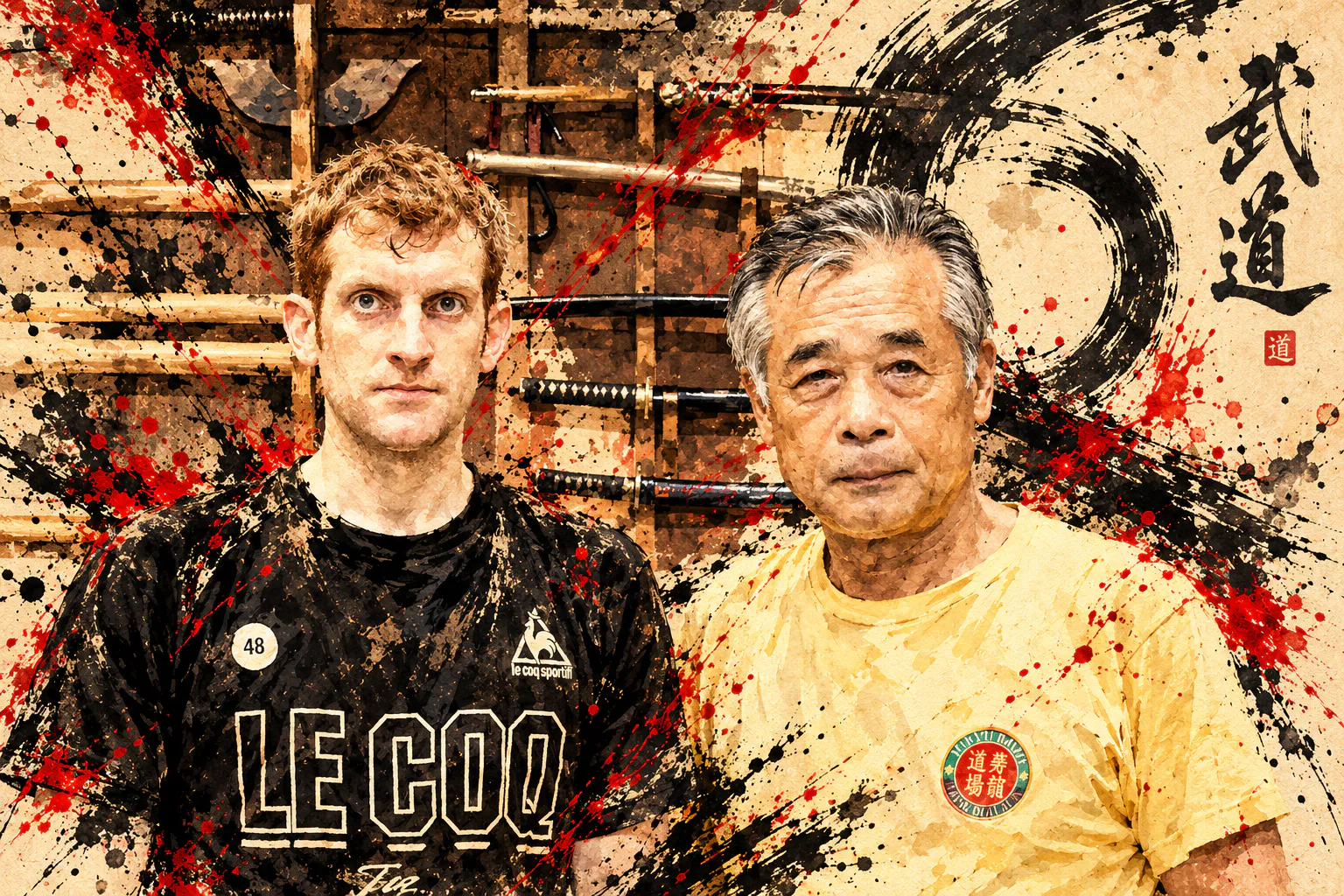
Training in Japan
Hartung passed the Bujinkan godan test in March 2005 and moved to Japan shortly afterward.
He first lived in rural Gunma, traveling several hours to train at the Bujinkan Honbu, in Ayase, and with Oguri Kōichi in Tochigi. After nine months he moved to Kasukabe, where proximity to the Honbu made a six-day training schedule possible.
During the Kasukabe years, he became a member of Noguchi Yukio’s dojo and continued regular training with Hatsumi Masaaki and Oguri. Daily life also included kendo practice through the schools where he taught English. These years placed him in sustained contact with Japanese teachers and resident practitioners from around the world.
Broader study
In 2008, conversations with fellow practitioners encouraged Hartung to seek more concentrated study of Japanese swordsmanship and other traditional methods. His broader training included study with Kuroda Tetsuzan, Kōno Yoshinori, and Kaminoda Tsunemori, alongside his continuing Bujinkan practice.
These experiences inform his approach to posture, timing, distance, weapons, and the relationship between kata and adaptable movement.

Return to the United States
Hartung returned to the United States in the fall of 2010 and continued training, teaching, attending and hosting events, and making periodic return visits to Japan.
In October 2018, he established Bujinkan Roselle Dojo. Fox Valley Budō Kai is the next stage of that teaching path: a focused South Elgin dojo planned for early 2027, with Bujinkan Budō Taijutsu as its primary regular program.
Training philosophy
Confidence helps us continue, honest doubt prompts investigation, and sustained effort turns instruction into skill.
Teacher and student share responsibility. The teacher guides and corrects; the student must engage honestly and take ownership of progress.
Attending class introduces material. Skill develops through thoughtful repetition and personal practice between scheduled sessions.
Kihon and kata preserve technical problems worth investigating. Accuracy comes before variation, and neither is treated as empty choreography.
Controlled drills and changing conditions help students examine whether posture, timing, distance, and technique remain reliable.
The South Elgin dojo
Instruction is individualized and direct. Material is demonstrated, practiced with partners, corrected in detail, and revisited through fundamentals, kata, drills, and questions. Traditional terminology and historical context are explained rather than used as decoration.
The aim is not rapid rank, spectacle, or imitation. It is the patient development of genuine movement and judgment in a setting where beginners and experienced practitioners can continue learning.
Your first step
Tell us about your interest in training, and we will share introductory class opportunities and confirmed opening details as they become available.