Martial Arts History
Martial Arts History
How Japanese rank systems and European teaching innovations created the belt progression familiar to martial artists today.
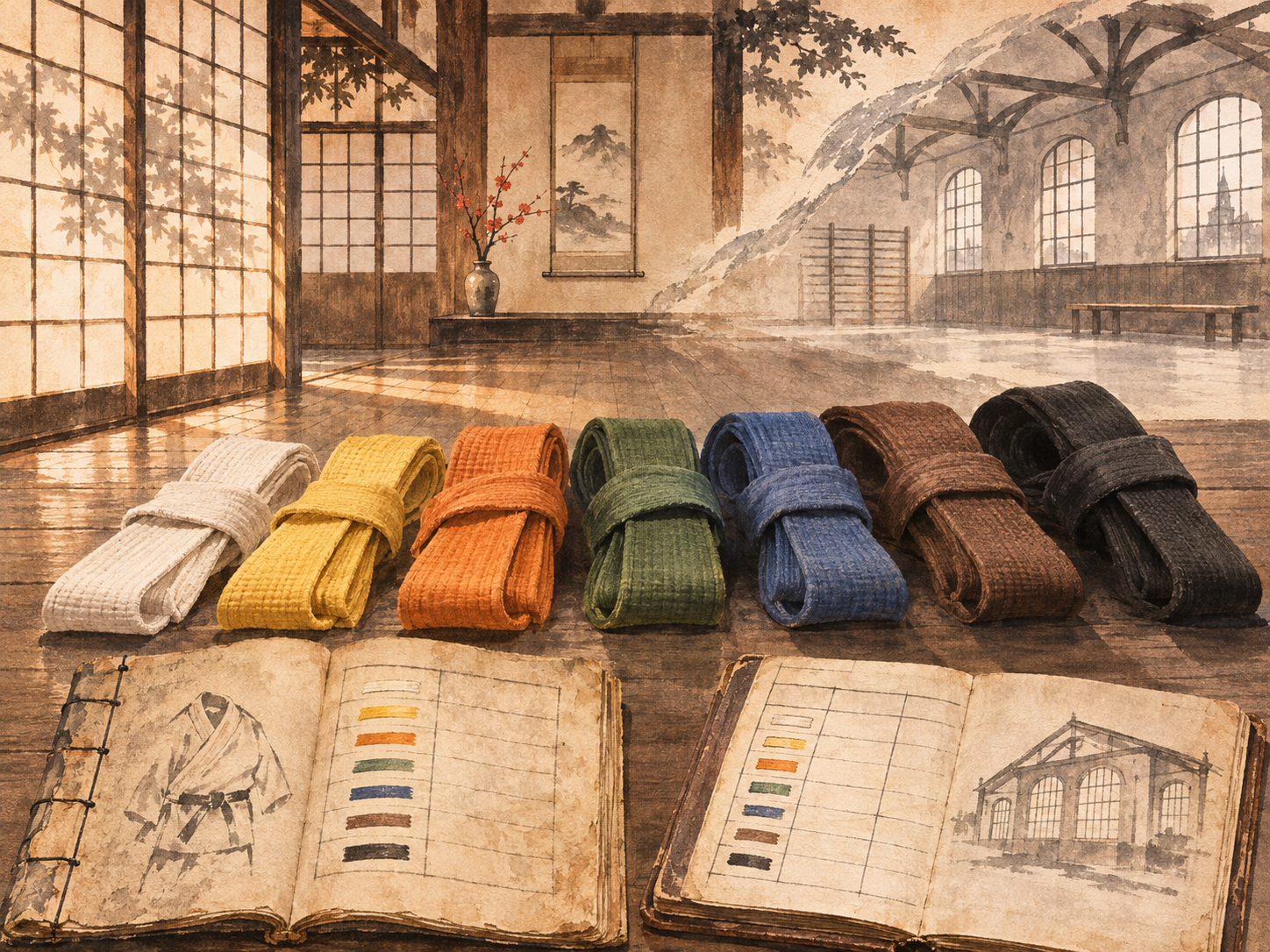
Walk into almost any modern martial arts dojo, and you will see students wearing belts in white, yellow, orange, green, blue, brown, and black. Each color identifies a stage of progress, and most students naturally associate the system with Japanese martial arts tradition.
The familiar sequence, however, has a surprisingly recent history. Japanese martial educators introduced formal ranks and used different belt colors during the late nineteenth and early twentieth centuries. Then instructors in Britain and France developed the multicolored progression that eventually spread across much of the martial arts world.
Popular accounts often credit Europe with inventing colored belts outright. That claim goes too far. Japanese records document several belt colors decades before the European system reached its familiar form. The more interesting history shows how instructors in Japan and Europe reshaped martial arts education, each building upon earlier developments.
Before Colored Belts: Classical Licensing
Japan's classical martial traditions, or koryū bujutsu (古流武術), generally recognized progress through transmitted teachings, licenses, and written documents rather than a standard series of colored belts.
Individual ryūha (流派) developed their own practices. A school might grant a mokuroku (目録), a catalog of teachings, or award menkyo (免許), a license acknowledging a particular level of attainment or authority. Some traditions used menkyo kaiden (免許皆伝) to recognize complete transmission of their curriculum.
These terms did not carry identical meanings across every school. Each tradition determined how students advanced, what teachers transmitted, and which documents established teaching authority. Many schools also maintained internal stages of instruction that a modern observer might not immediately recognize as ranks.
Such systems emphasized a student's relationship to a particular curriculum and line of transmission. They did not generally display progress through the standardized white-to-black color sequence that modern practitioners know today.
Kanō Jigorō and the Modern Rank System
Kanō Jigorō (嘉納治五郎, 1860–1938) established the Kōdōkan (講道館) in 1882 and placed the study of jūdō (柔道) within a broader educational program. Kanō drew from classical jūjutsu (柔術), especially Tenjin Shin'yō-ryū (天神真楊流) and Kitō-ryū (起倒流), but he reorganized training, instruction, and student evaluation.
In 1883, Kanō awarded shodan (初段), or first-degree rank, to Tomita Tsunejirō (富田常次郎) and Saigō Shirō (西郷四郎). These promotions marked an important early step in the Kōdōkan's dan (段) system. The school eventually distinguished yūdansha (有段者), students with dan ranks, from mudansha (無段者), students without them.
Belts made those distinctions visible. Black became the familiar color for dan holders, while white identified beginners and other students without dan rank. Brown also marked more advanced kyū (級) practitioners in some arrangements.
We should not imagine, however, that every Japanese jūdō institution used only white and black belts until Europeans introduced other colors. Japanese schools and martial organizations experimented with additional distinctions well before the 1920s.
Colored Belts in Japan Before the European System
Japanese scholarship provides some of the strongest evidence against the claim that Europe invented all colored rank belts.
In a 2015 study of the Second Higher School jūdō club, historian Nakajima Tetsuya (中嶋哲也) examines club documents from the period between 1893 and 1914. He identifies a September 1903 revision of the club's ranking regulations that appeared in the 1904 Shōshikai Zasshi (尚志会雑誌). The regulations assigned black belts to the highest club grade and red belts to its second and third grades.1
The Sendai arrangement did not establish a nationwide system, but it shows that a Japanese jūdō club deliberately used more than one belt color to distinguish student grades before the European developments of the 1920s.
Mizoguchi Noriko (溝口紀子) presents even more extensive evidence in her University of Tokyo dissertation, Joshi Jūdō no Tanjō: Kōdōkan Shinwa no Bunseki (女子柔道の誕生―講道館神話の分析―), or The Birth of Women's Jūdō: An Analysis of the Kōdōkan Myth. Her research reproduces the Dai Nippon Butokukai's (大日本武徳会) 1906 Jūjutsu Trainee Grades and Promotion Regulations (大日本武徳会柔術講習員等級及進級規程).2
Those regulations assigned several colors to specific grades. The Butokukai had already established itself as a major Japanese martial arts organization after its founding in 1895. Its 1906 regulations therefore carry considerable historical weight. They demonstrate that an influential Japanese organization assigned green, yellow, purple, brown, white, and black belts to defined levels of training more than twenty years before the better-known British progression.
The Kōdōkan's official chronology adds another detail: on March 1, 1911, it introduced pale indigo-blue belts (tan-ai-iro, 淡藍色) for beginners.8
These examples do not prove that one Japanese organization invented every later variation. They do establish a more modest, firmer conclusion: Japan used multiple belt colors to identify martial arts grades before the European rainbow progression took shape.
The Budokwai and the British Belt Progression
In January 1918, Japanese martial artist Koizumi Gunji (小泉軍治, 1885–1965) founded the Budokwai (武道会) in London. The club began as a center for Japanese martial arts and culture. After Kanō visited in 1920, the Budokwai developed close ties to Kōdōkan jūdō and became a major force in British martial arts education.
During the 1920s, Koizumi and his colleagues sought a clearer way to recognize progress through the kyū grades. The International Judo Federation dates the Budokwai's use of colored belts to 1926 and notes their appearance in club records in 1927.9
The early British arrangement included white, yellow, green, blue, and brown. Orange later joined the sequence. The result closely resembles the progression that many martial arts schools use today:
White → Yellow → Orange → Green → Blue → Brown → Black
Researcher Maja Sori Doval (マーヤ・ソリドーワル) discusses this development in her Japanese-language study of jūdō education in Germany. She also identifies the Budokwai's 1926–1927 changes as a significant development in European jūdō ranking.3
Accounts differ on the precise date when orange entered the sequence, so we should not treat the seven-color arrangement as an unchanging scheme from its first day. Nevertheless, the historical evidence associates the development of this increasingly detailed and internationally influential color ladder with the European jūdō community of the 1920s.
One detail deserves emphasis: a Japanese instructor led this innovation in a European setting. Its history resists any simple division between a supposedly unchanging Japanese tradition and an exclusively European invention.
Kawaishi and the Growth of Jūdō in France
Britain helped shape the modern belt sequence, but France helped spread it.
Kawaishi Mikinosuke (川石酒造之助, 1899–1969) taught jūdō in Britain before establishing himself in France in the mid-1930s. He sought teaching methods that suited European students while retaining jūdō's core techniques and principles.
His approach, which later became known as the Méthode Kawaishi, organized techniques into numbered categories. Instead of requiring students to learn every technique through Japanese terminology alone, he gave them a classification that offered clear points of reference. In this system, for example, ō-soto-gari (大外刈), the major outer reap, appears as the first leg technique.
Kawaishi also used colored belts to mark intermediate stages of progress. Students could work toward recognizable short-term goals as they developed the skills necessary for higher grades. The colors provided a visible structure for instruction, assessment, and motivation.
Hoshino Akira (星野映) examines this process in his 2019 study of jūdō in Paris during the German occupation from 1940 to 1944. Hoshino discusses Kawaishi's teaching methods, including the belt system, alongside the clubs and organizational networks that helped French jūdō grow.4
Kawaishi's influence extended beyond France as European instructors adopted and adapted elements of his method. Andreas Niehaus also places European innovations within the broader history of jūdō's internationalization.5
The historical importance of Kawaishi's approach lies not only in the belt colors themselves. He connected visible stages of advancement to a practical teaching structure that supported jūdō's expansion in Europe.
From Jūdō to Other Martial Arts
As jūdō expanded internationally, other martial arts adopted elements of its organizational model. Modern karate provides one prominent example. During the twentieth century, karate organizations embraced features of Japanese budō (武道), including formal uniforms and dan ranking. Many later introduced multiple colored kyū belts.
Other systems made similar choices, but each organization developed its own grading rules. We should not assume that every karate, taekwondo, or modern jūjutsu school copied its exact color progression directly from Koizumi or Kawaishi.
No single sequence governs all martial arts. The All Japan Judo Federation (全日本柔道連盟) explains that Japanese jūdō does not follow one nationally uniform kyū-belt color arrangement, even though it standardizes colors for dan ranks.10
A green belt can therefore signify very different levels of experience from one school to another. Belt colors show a student's position within a particular institution's grading scheme. They do not offer a universal measurement of technical skill.
The Myths Behind the Colors
Martial artists often encounter a charming story about how the black belt began. According to the tale, a beginner received a white belt and wore it for so many years that sweat and dirt slowly darkened the fabric until it turned black.
Other stories assign each color a symbolic meaning. White supposedly represents innocence, yellow the rising sun, green new growth, and black maturity or mastery.
Instructors may find these stories useful as metaphors, but historical evidence does not establish them as the original explanation for the belt progression. Japanese ranking regulations and European club histories instead show people deliberately assigning specific belt colors to specific grades.
Students did not earn black belts by accumulating dirt. Organizations created rank distinctions, and instructors chose colors that students and teachers could recognize.
Modern schools may attach thoughtful philosophical interpretations to their colors. Those interpretations deserve consideration within each school's teaching culture. They should not, however, replace documented history.
What Belt History Teaches About Tradition
The history of colored belts illustrates a larger pattern in martial arts history: transmission does not preserve every detail unchanged.
Kanō reorganized classical jūjutsu teachings into a new educational framework. Japanese clubs and martial organizations experimented with grade distinctions. Koizumi and the Budokwai developed a more detailed color sequence in Britain. Kawaishi integrated colored belts into an influential teaching method in France.
Each generation responded to the needs of its students and institutions. The resulting changes did not automatically erase the underlying art. They changed how teachers organized and communicated progress.
For anyone studying koryū, this history also cautions against projecting the familiar white-to-black sequence backward into Edo-period martial arts. Classical schools relied on their own arrangements of teaching, licensing, and transmission. Modern belt ranks reflect a different institutional history.
Neither a classical license nor a modern colored belt guarantees technical depth by itself. Both derive their significance from the standards, instruction, and relationships behind them. A belt tells us that an organization recognizes a student's progress. It cannot, on its own, tell us how well that student understands the art.
So, Did Europeans Invent Colored Belts?
Not in the broadest sense. Japanese sources document multiple belt colors by 1903 and provide detailed grade-to-color regulations by 1906. Those sources predate the well-known European developments.
Europe nevertheless played a decisive role in creating and popularizing the modern multicolored progression. In London during the 1920s, the Budokwai developed a clearer sequence for kyū-level advancement. In France during the 1930s and 1940s, Kawaishi connected colored belts to an instructional system that influenced jūdō far beyond his own dojo.
The familiar colored-belt ladder therefore represents a modern collaboration across cultures rather than an ancient samurai custom. Its story reminds us that martial arts traditions evolve not only through the techniques practitioners preserve, but also through the ways teachers help new generations learn them.
Sources and Further Reading
- 中嶋哲也 (Nakajima Tetsuya). (2015). 「旧制二高柔道部の歴史的実態:1893–1914年を中心に」. スポーツ科学研究, 12, 1–20. Read the article at Waseda University. Documents the 1903 Second Higher School regulations.
- 溝口紀子 (Mizoguchi Noriko). (2015). 『女子柔道の誕生―講道館神話の分析―』. Doctoral dissertation, University of Tokyo. University of Tokyo dissertation summary. The dissertation discusses the 1906 Dai Nippon Butokukai belt regulations; the linked summary is not the full dissertation.
- マーヤ・ソリドーワル (Maja Sori Doval). (2017). 「ドイツにおける柔道教育の展開及びその現状―ドイツ柔道の展開とドイツの柔道教育の特性、現状及びその問題点―」. 津田塾大学紀要, 49, 79–94. Read the article.
- 星野映 (Hoshino Akira). (2019). 「1940–1944年の占領期パリにおける柔道の確立:フランス柔術クラブの活動を中心に」. 体育学研究, 64(1), 187–203. Read the article at J-STAGE.
- Niehaus, Andreas. (2006). “‘If You Want to Cry, Cry on the Green Mats of Kôdôkan’: Expressions of Japanese Cultural and National Identity in the Movement to Include Judo into the Olympic Programme.” The International Journal of the History of Sport, 23(7), 1173–1192. Journal article.
- De Crée, Carl, and David A. Edmonds. (2012). “A Technical-Pedagogical and Historical Reflection on the Conceptual and Biomechanical Properties of Kōdōkan Jūdō's Ko-uchi-gari.” Comprehensive Psychology. Journal article. Provides background on Kawaishi's instructional system.
- Brough, David, Slaviša Bradić, Mike Callan, Lance Gatling, and Llyr Jones. (2023). “The British Ju-jitsu Society and the Influence of Kodokan Judo on Early Jujutsu in the UK.” Martial Arts Studies, 13, 42–60. Open-access article. Provides context for early British jūjutsu and jūdō.
- Kōdōkan (講道館). 「年表」. Official historical chronology. Notes the March 1911 pale indigo-blue beginner belt rule.
- International Judo Federation. “The Belt: Myth and Reality of an Essential Symbol.” Read the historical article. Discusses the Budokwai's belt colors and Kawaishi's influence.
- All Japan Judo Federation (全日本柔道連盟). 「柔道衣・帯について」. Federation guidance on uniforms and belts. Describes current Japanese belt conventions.