Training Principles
The Value of an Analog Practice in an Increasingly Digital World
Explore how traditional Japanese martial arts develop attention, embodied skill, and human connection through practice in an increasingly digital world.
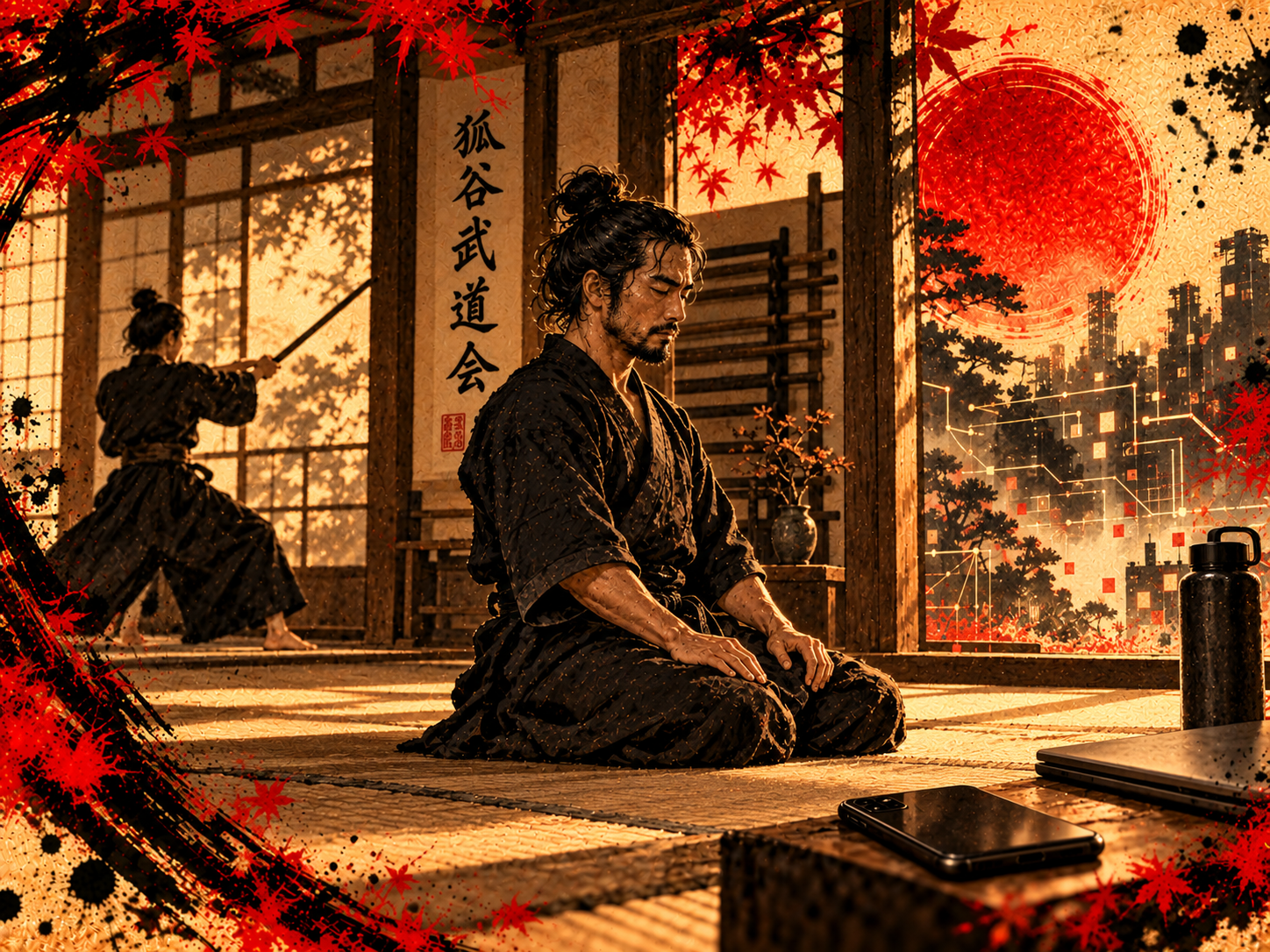
We live in an age when information is immediately accessible, communication is nearly instantaneous, and artificial intelligence can generate answers to questions in seconds. Social media provides endless opportunities to observe the lives, accomplishments, and opinions of others. Nearly everything we want to know appears to be only a few keystrokes away.
Yet there is an important distinction between having access to information and possessing knowledge, and a still greater distinction between knowing something and being able to do it.
Traditional Japanese martial arts offer an increasingly uncommon experience: the opportunity to step away from screens, engage directly with other people, and develop abilities that cannot simply be downloaded, generated, or acquired by watching someone else.
In a world becoming increasingly digital, the practice of budō offers something distinctly analog.
The Illusion of Knowledge
Today, anyone can watch thousands of videos demonstrating martial arts techniques. We can study the movements of accomplished practitioners, read explanations of complicated principles, and ask artificial intelligence to describe nearly any aspect of martial arts history or practice.
These resources can be useful. They provide opportunities for learning that would have been unimaginable to previous generations.
However, watching a movement is not the same as possessing the ability to perform it.
A person can watch hundreds of videos about swimming without learning how to swim. They can study the mechanics of playing a musical instrument without developing the coordination necessary to produce music.
Martial arts present a similar problem.
Understanding an explanation of balance, distance, or timing does not necessarily provide the ability to recognize or control these qualities while moving with another person.
The missing element is experience.
Information can help guide practice, but it cannot replace the process through which physical skill is actually developed. Our essay 学習 — Learning explores this relationship between information and understanding.
The Body Cannot Be Replaced by an Algorithm
Artificial intelligence can analyze movement, describe techniques, and offer explanations of physical principles. Digital technology can even provide feedback about posture, speed, and coordination.
Nevertheless, there remains a difference between receiving information about a movement and developing the ability to perform it.
In Japanese martial arts, much of what students learn is developed through bodily experience.
A student must learn how to maintain balance while moving, recognize changes in a partner's position, adjust the amount of muscular effort being used, and respond to changes in distance and timing.
These are not merely intellectual problems. They require the development of perception, coordination, and physical understanding.
The Japanese concept of 身体知 (shintai-chi), or embodied knowledge, offers a useful way of considering this distinction.
Some knowledge is expressed not primarily through words, but through the trained capabilities of the body.
You may understand the explanation of a technique, yet be unable to perform it correctly. Only through practice does that understanding begin to become an ability.
Technology can support this learning process, but the practitioner must still undertake the physical work.
In the Dōjō, You Must Be Present
Much of our digital experience allows us to divide our attention. We move between applications, respond to messages, scroll through short videos, and consume information in small fragments.
In the dojo, the demands are different.
When practicing with another person, your attention must return to the movement taking place in front of you.
You must observe where your partner is standing, recognize their balance, understand your distance, and remain aware of your own posture and movement.
A lapse in attention can result in a missed movement, poor coordination, or an unsafe training situation.
This creates a form of engagement that differs considerably from the passive consumption of digital content.
The practice requires participation rather than observation alone.
You cannot scroll past a difficult technique and expect to have learned it. You cannot skip the awkward early stages of developing coordination.
You must be present, make mistakes, receive correction, and try again.
Social Media Shows the Result, Not the Years of Practice
Social media platforms such as Instagram, TikTok, and YouTube make it easy to encounter impressive demonstrations of physical ability.
A complicated technique may appear effortless. A movement refined through years of training may be presented in a fifteen-second video.
What the viewer rarely experiences is the process behind that performance.
The thousands of repetitions, corrections, failed attempts, and gradual discoveries are largely invisible.
This can create a misleading impression of how skill is acquired.
We see the finished movement without witnessing the difficult process through which it was developed.
Traditional martial arts offer a different perspective.
Students encounter the actual demands of learning. They discover that a movement which appears simple when demonstrated by an experienced practitioner can be surprisingly difficult to reproduce.
They learn that progress is not always immediate, visible, or easily measured.
This experience can provide a useful counterbalance to a culture that often emphasizes the appearance of achievement over the process of acquiring it.
稽古 (Keiko): The Value of Returning to Practice
The Japanese term 稽古 (keiko) refers to practice or training.
Within traditional martial arts, practice provides opportunities to continually revisit and refine familiar movements.
Unlike digital information, which can often be retrieved whenever it is needed, physical skill depends upon continued cultivation.
A person who stops practicing may retain an intellectual understanding of a technique, yet find that their coordination, timing, or ability to perform it has diminished.
Knowing what should be done does not guarantee the ability to do it.
Furthermore, repetition alone is insufficient. Students must learn to observe their mistakes and recognize what requires improvement.
Through continued practice, the practitioner gradually develops a more refined understanding of movement.
In a culture that often rewards immediacy, keiko offers a different relationship with time.
Progress cannot always be accelerated simply because we wish it to happen faster. Read why martial arts training is a lifelong process for a broader view of continued practice.
Learning Through Human Contact
Another important feature of traditional martial arts is that much of the learning process takes place directly between people.
An instructor demonstrates a movement. Students observe and attempt to reproduce it.
A training partner provides resistance, changes position, or responds in a way that reveals a weakness in the technique.
The instructor notices an error and provides a correction.
Each of these interactions contributes information that may be difficult to communicate through written explanations or videos alone.
In Japanese martial arts, 見取り稽古 (mitori geiko) refers to learning through careful observation.
Students gradually learn to notice details they may initially overlook. They begin recognizing subtle changes in movement, posture, and timing.
Yet observation must eventually be joined with physical practice.
A student may see what an instructor is doing without yet possessing the bodily understanding necessary to reproduce it.
The interaction between observation, instruction, correction, and physical experience is central to the development of martial skill.
In this environment, other people are not merely images on a screen. They are active participants in the learning process.
There Are No Shortcuts to 自得 (Jitoku)
Two concepts particularly relevant to traditional Japanese martial arts are 工夫 (kufū) and 自得 (jitoku).
Kufū involves thoughtful effort, investigation, and finding ways to overcome difficulties.
Jitoku refers to understanding or skill personally acquired through one's own experience.
An instructor may explain a principle many different ways. A student may read about it, watch demonstrations, and understand the explanation intellectually.
Yet there may come a moment during practice when the student finally recognizes the principle through their own movement.
What was previously an abstract explanation becomes something they can feel and perform.
This form of understanding cannot simply be transferred from one person to another as information.
It must be developed through the learner's own effort.
Artificial intelligence may provide an excellent explanation of balance. A video may offer a clear demonstration of timing.
But neither can perform the movement on the student's behalf.
The practitioner must still undertake the work of acquiring the skill.
A Space Where Progress Does Not Need an Audience
In the digital world, many activities become opportunities for public presentation.
We photograph experiences, share accomplishments, and sometimes measure success through likes, views, and reactions.
There is nothing inherently wrong with documenting or sharing progress. Martial artists themselves can benefit from videos, photographs, and online communities.
Yet much of the meaningful work in martial arts takes place without an audience.
A student makes a small correction to their posture. They begin recognizing unnecessary tension. They improve their ability to maintain balance during movement.
These accomplishments may not appear impressive in a short video.
They may be nearly invisible to anyone other than the student and their instructor.
Nevertheless, they can represent genuine developments in skill.
The value of these improvements does not depend on whether anyone outside the dojo sees them.
Training provides an opportunity to pursue improvement for its own sake, without needing to turn every accomplishment into public content.
修行 (Shugyō): Choosing a More Deliberate Path
Within Japanese martial traditions, 修行 (shugyō) is associated with sustained, disciplined training and the rigorous pursuit of a practice.
It offers a useful contrast to the constant novelty of much digital entertainment.
In the dojo, students return to the same fundamental movements repeatedly.
They confront difficulties that cannot always be solved immediately.
They gradually discover that improvement requires persistence, reflection, and appropriate effort.
The objective is not endless repetition for its own sake, but continued refinement of understanding and ability.
This deliberate approach to learning becomes particularly valuable in an environment where distractions and competing demands on attention are constant.
Martial arts offer a place where we can choose to concentrate on one demanding activity and pursue it seriously.
Traditional Martial Arts Are Not Opposed to Technology
None of this requires rejecting modern technology.
Digital resources have made valuable contributions to the study and preservation of Japanese martial arts.
Historical documents that once required traveling to distant libraries can now sometimes be studied online.
Video recordings allow practitioners to examine movements, preserve demonstrations, and maintain connections across great distances.
Artificial intelligence can assist with researching historical sources, organizing information, and exploring unfamiliar subjects, although its outputs still require verification.
The distinction is not between technology and tradition.
It is between using technology to support learning and mistaking access to information for the acquisition of skill.
The tools available to us may change, but the fundamental challenge of learning to move skillfully remains.
No matter how advanced our technology becomes, the individual practitioner must still practice.
Why an Analog Practice Matters for Teens and Adults
For teenagers growing up surrounded by digital communication, martial arts can provide an opportunity to engage in a structured activity that demands direct participation.
They learn to observe, cooperate with training partners, receive correction, and approach difficult tasks through practice.
For adults whose work and daily lives increasingly involve screens, martial arts can offer a different kind of challenge.
Instead of spending another hour consuming information, they can devote time to developing physical abilities through direct experience.
The dojo provides a setting in which people of different ages and backgrounds can work toward the same objective: becoming more capable through continued practice.
The value is not simply that training takes place away from a screen.
It is that the practice requires a form of attention, effort, and human interaction that cannot be reduced to digital consumption.
Rediscovering Practice at Fox Valley Budō Kai
At Fox Valley Budō Kai in South Elgin, Illinois, we approach traditional Japanese martial arts as a continuing process of learning and refining skill.
Our planned primary program is Bujinkan Budō Taijutsu, through which students investigate movement, posture, balance, distance, timing, and the principles underlying martial techniques.
Training involves direct instruction, observation, partner practice, correction, and continued effort.
Students are encouraged to develop understanding rather than simply memorize movements.
Opening is planned for early 2027. We welcome inquiries from teens and adults ages 15 and older in South Elgin, Elgin, St. Charles, Bartlett, and the surrounding Fox Valley communities. See our planned schedule and enrollment information for current details.
Whether you are beginning martial arts for the first time or returning to training after years away, the dojo offers an opportunity to engage in something tangible, challenging, and meaningful.
Some Things Must Still Be Learned by Doing
Technology will continue to change how we work, communicate, and acquire information.
Artificial intelligence will undoubtedly influence how knowledge is organized and shared.
Yet the development of human skill remains rooted in experience.
A description of balance is not balance. An explanation of timing is not timing. A demonstration of movement is not the ability to move.
These things must be cultivated through practice.
Traditional Japanese martial arts remind us that not every meaningful accomplishment can be accelerated, automated, or experienced through a screen.
Some things still require us to show up, pay attention, make mistakes, and try again.
In an increasingly digital world, perhaps this is one of the most valuable things an analog practice can offer.