Training Principles
Learning to Use Less Strength: Why Relaxation Matters in Martial Arts
Explore datsuryoku: releasing unnecessary tension while maintaining posture, balance, timing, and effective strength in Japanese martial arts.
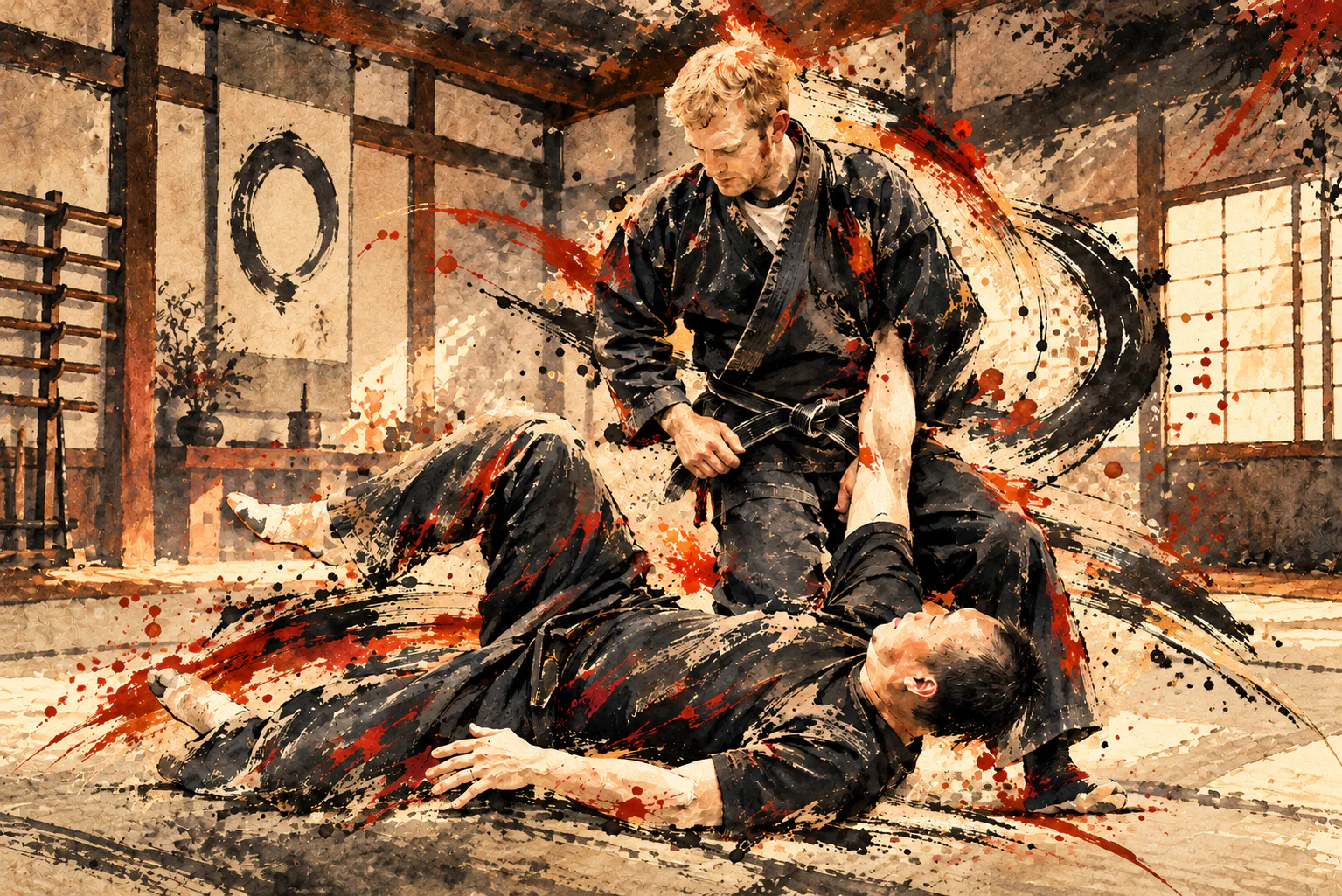
When people begin learning martial arts, they often assume that greater strength, faster movement, and increased physical effort will produce better techniques. When something does not work, the natural response is frequently to try harder. Yet one of the more difficult lessons in traditional Japanese martial arts is that excessive effort can sometimes become an obstacle to developing skill.
Learning to move effectively does not necessarily mean learning to exert more strength. It often involves learning when to apply strength, when to release it, and how to coordinate the body so that unnecessary effort does not interfere with the intended movement.
Within Japanese martial arts, this idea is often discussed through the concept of 脱力 (datsuryoku), commonly translated as relaxation or the release of unnecessary muscular tension.
Why Beginners Tend to Use Too Much Strength
Consider what happens when you attempt an unfamiliar physical activity. Whether learning to swim, play a musical instrument, or perform a new martial arts technique, the body often responds with more tension than the task requires.
The shoulders may rise, the hands may grip too tightly, the breath may become restricted, and muscles that should be relatively relaxed begin working against the movement.
This is especially common when a student feels uncertain about what to do. Without a clear understanding of the movement, increased muscular effort can become a way of compensating for a lack of coordination.
In martial arts, this excessive tension can create several problems. Movements may become stiff or predictable, balance may be compromised, and the student may struggle to adjust when a training partner changes position.
The problem is not strength itself. Strength is useful and sometimes necessary. The difficulty arises when muscles are engaged unnecessarily or when effort is applied at the wrong time or in the wrong direction.
Understanding 脱力 (Datsuryoku)
The Japanese term 脱力 combines 脱, meaning to remove or release, with 力, meaning strength or force. In the context of physical training, it is commonly used to describe releasing unnecessary muscular effort.
However, the idea should not be misunderstood. Relaxation in martial arts does not mean becoming limp, abandoning structural support, or removing all muscular engagement.
Standing, moving, maintaining posture, and interacting with another person all require muscular activity. Even apparently effortless movement depends upon precise coordination.
The objective is better understood as learning to distinguish necessary effort from unnecessary tension.
A student gradually discovers that a movement can sometimes be performed more effectively by removing interference rather than adding force.
This distinction is particularly important in traditional Japanese martial arts, where positioning, timing, distance, and balance can influence the outcome of a technique as much as raw physical strength.
Relaxation and Structure Must Work Together
A common mistake is to treat relaxation and structure as opposing qualities. Students may assume that a strong posture requires constant tension, while a relaxed posture must necessarily be weak.
In practice, effective movement requires an appropriate relationship between muscular engagement, skeletal alignment, balance, and coordination.
For example, holding the shoulders rigidly while attempting to move the arms can restrict their range of motion. Similarly, an unnecessarily tight grip may make it more difficult to change the position of the hands or respond to movement.
Releasing unnecessary tension can allow the body to move with greater freedom. However, this freedom must remain supported by appropriate posture and control.
The goal is neither rigidity nor complete relaxation. It is the ability to organize the body according to the demands of the movement.
This is one reason martial arts students spend considerable time studying fundamental movement. The relationship between posture, balance, and muscular effort must gradually become something they can recognize and regulate.
Why Timing and Distance Can Matter More Than Force
Imagine trying to move a heavy door. Pushing against the wrong part of the door or in an ineffective direction may require considerable effort. Applying force at the appropriate place and in the appropriate direction makes the task easier.
Martial arts movement presents a much more complex problem because another person is continually able to change their position, balance, and response. Nevertheless, the underlying lesson remains useful: the amount of force applied is only one part of what determines the outcome.
In Japanese martial arts, the concept of 間合 (maai) concerns the relationship of distance and spatial positioning between practitioners.
Equally important is 拍子 (hyōshi), often associated with rhythm and timing.
A student who recognizes changes in distance, balance, and timing may find opportunities that are not available through greater muscular effort alone.
Training therefore involves learning to perceive these relationships and coordinate movement accordingly. Our article on what weapons training teaches about distance explores another way to study these principles.
Relaxation supports this process when it allows the student to move and respond without unnecessary muscular interference.
Developing Body Awareness Through Martial Arts
Before a student can release unnecessary tension, they must first learn to recognize it.
This requires developing awareness of posture, muscular effort, balance, and movement. Such awareness is sometimes discussed through the Japanese term 身体感覚 (shintai kankaku), or bodily sensation and awareness.
A beginner may be unaware that their shoulders are raised, that they are leaning too far forward, or that one part of the body is moving independently of the rest.
An instructor may identify these problems through observation and provide correction. However, the student must gradually learn to recognize the same problems through their own experience.
This is an important transition in the development of skill. Rather than depending exclusively on external correction, students begin developing the ability to evaluate and adjust their own movement.
In time, they may become sensitive to differences that were initially difficult to perceive: a slight change in balance, unnecessary tension in the arms, an inefficient shift of weight, or a moment when movement becomes restricted.
These discoveries may appear small, but they form an important part of meaningful progress.
Repetition Is Not Enough: The Importance of 稽古 (Keiko)
Students often associate improvement with repetition. While repetition is essential to developing familiarity and consistency, repeating a movement without attention does not necessarily produce better skill.
Consider a student who consistently performs a technique with excessive shoulder tension. Repeating that movement hundreds of times may reinforce the same habit rather than correct it.
Meaningful practice requires observation, feedback, reflection, and the willingness to change how a movement is performed.
The Japanese term 稽古 (keiko) refers to practice or training. Within traditional martial arts, it provides a useful framework for considering how repeated practice contributes to the development of understanding.
Two additional concepts are relevant: 工夫 (kufū), the process of thoughtful experimentation and finding ways to overcome a problem, and 自得 (jitoku), an understanding or skill personally acquired through experience.
An instructor can explain that a student is using too much force. They can demonstrate a more efficient movement and provide exercises intended to develop it.
However, the student must eventually discover the necessary coordination through their own practice.
Being told to relax is not the same as understanding how to relax while maintaining effective movement. That distinction is learned through continued training. Read Budō and Proper Practice for a related reflection on developing understanding through practice.
Does This Mean Strength Is Unimportant?
No. Physical strength remains an important human capability, and martial arts can place substantial demands on the body.
Strength, mobility, endurance, and general conditioning can support martial arts performance. The development of these qualities should not be dismissed.
The lesson of datsuryoku is not that strength is unnecessary, but that strength alone is insufficient.
Someone who relies exclusively on force may struggle when that force is poorly directed, applied too late, or opposed by a person with better positioning.
Similarly, a person who attempts to remain completely relaxed without appropriate structure or muscular engagement may be unable to perform the required movement.
Good martial arts practice develops the ability to use the body appropriately. Sometimes that requires greater effort. At other times, it requires less.
Why This Matters for Adults Beginning Martial Arts
Adults considering martial arts training sometimes worry that they lack the strength, flexibility, or athletic ability necessary to begin.
Although martial arts can be physically demanding, much of the early learning process involves coordination and understanding rather than demonstrations of athletic superiority.
Students can work toward becoming more capable movers by gradually improving their posture, balance, movement awareness, and ability to apply effort effectively.
This does not mean that traditional martial arts are effortless, nor does it guarantee that technical skill will overcome every difference in strength or size.
It means that effective training provides opportunities to develop qualities beyond raw muscular force.
For many adults, discovering that improvement depends on learning how to move, rather than simply trying harder, can change the way they approach physical practice. Our guide to starting martial arts as an adult addresses common questions about beginning training.
Learning Efficient Movement at Fox Valley Budō Kai
Fox Valley Budō Kai is preparing for a planned early-2027 opening in South Elgin, Illinois. Our planned primary program is Bujinkan Budō Taijutsu, with an emphasis on traditional Japanese martial arts practice.
Training emphasizes the development of skill through continued practice, observation, correction, and an understanding of fundamental principles.
Students study movement, positioning, timing, distance, balance, and the appropriate application of strength. The objective is not simply to memorize techniques, but to gradually develop the ability to perform them with greater understanding.
For beginners, this starts with establishing fundamental movement patterns and becoming more aware of how the body is used.
For experienced practitioners, the same principles offer continued opportunities for refinement.
Our dojo welcomes inquiries from teenagers and adults ages 15 and older in South Elgin, Elgin, St. Charles, Bartlett, and the surrounding Fox Valley communities.
The Goal Is Better Movement, Not Simply Less Effort
Learning to use less strength is not about avoiding difficulty or removing effort from martial arts practice.
It is about developing the ability to recognize what a movement requires and learning to eliminate unnecessary interference.
This takes patience, careful observation, and continued practice. Students must become willing to reconsider familiar habits and discover new ways of organizing their movement.
In traditional Japanese martial arts, even the simplest movement can become a subject of continued study.
The purpose is not merely to work harder, but to develop the skill to work more effectively.