New Students
What to Expect in a Traditional Japanese Martial Arts Class
Explore the structure of a Japanese martial arts class: dojo etiquette, quiet preparation, fundamentals, partner practice, and individual correction.
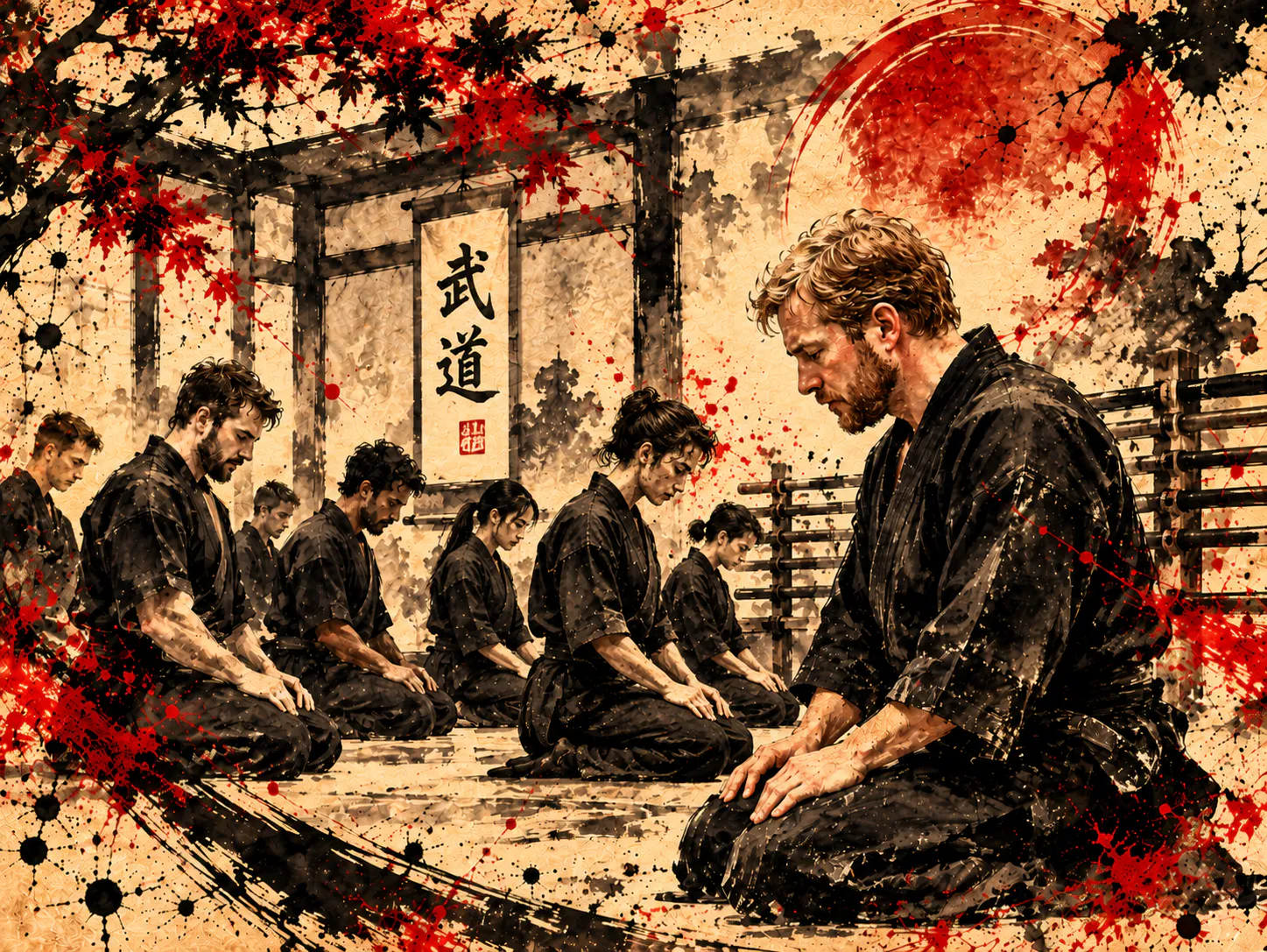
Walking into a traditional Japanese martial arts dojo for the first time can be unfamiliar. You may encounter Japanese terminology, formal etiquette, and methods of instruction that differ from those used in conventional fitness classes or competitive sports programs.
At Fox Valley Budō Kai in South Elgin, Illinois, opening is planned for early 2027. Our planned class structure combines traditional dojo etiquette with the progressive development of martial skill. This guide describes that approach; individual lessons and customs may vary between dojos.
Our planned primary program is Bujinkan Budō Taijutsu, a Japanese martial art that includes unarmed movement, striking, controlling, throwing, and the study of traditional weapons.
Although the particular techniques and subjects change from class to class, the general structure remains consistent. We begin with formal etiquette and a brief period of mental preparation, develop foundational movements, study techniques through demonstration, and refine our understanding through partner practice and individual correction.
For beginners, understanding this structure can make the first class considerably more approachable. You are not expected to know the customs, terminology, or techniques before arriving. These are things you gradually learn through practice.
1. Beginning Class: Bowing In and Dojo Etiquette
Class begins with a formal bowing ceremony, commonly referred to as 礼 (rei), or bowing.
At Fox Valley Budō Kai, the opening includes the traditional Bujinkan phrase:
詞韻波羅蜜大光明
Shikin Haramitsu Daikōmyō
This phrase is associated with traditional Bujinkan dojo etiquette. Interpretations vary, but it is commonly connected with ideas of insight, awakening, and the possibility of gaining understanding through experience.
The phrase is followed by two claps, a bow, and a final clap.
The instructor then turns to face the students, and the greeting お願いします (onegaishimasu) is exchanged.
In this context, onegaishimasu expresses a respectful request to practice and learn together. It acknowledges the cooperative relationship between instructor and students.
For new students, these customs may initially seem unusual. However, they are part of the established etiquette of the dojo. Beginners learn the procedures through explanation and observation.
The opening marks the beginning of practice and establishes an atmosphere of attention, respect, and shared responsibility.
2. 黙想 (Mokusō): Preparing the Mind for Practice
Following the opening etiquette, we begin with approximately thirty seconds of 黙想 (mokusō), a brief period of quiet reflection.
During this time, students are encouraged to mentally visualize their training and consider how the body performs the movements being studied.
This might involve imagining a familiar movement, recalling a previous correction, or directing attention toward the coordination of the body.
The purpose is not to achieve a particular meditative state or perform an elaborate mental exercise.
Rather, it is a short opportunity to prepare for practice and shift attention away from the concerns of daily life.
In an increasingly digital world, where attention is frequently divided between messages, screens, and other distractions, this deliberate transition into physical practice can be valuable.
For the duration of class, the objective is to concentrate on the process of learning and developing skill.
3. Foundational Movement: Learning to Use the Body
After the opening, training moves into foundational movements and exercises.
These establish the physical vocabulary upon which more complicated techniques are developed.
Depending on the lesson, students may practice elements such as:
- 構え (kamae): Posture, positioning, and the organization of the body.
- 体捌き (tai sabaki): Body movement and repositioning.
- 受身 (ukemi): Methods of receiving techniques and learning to fall or roll appropriately.
- 間合 (maai): Distance and spatial relationships.
- 脱力 (datsuryoku): Recognizing and releasing unnecessary muscular tension.
Beginners often discover that movements which appear simple can be surprisingly difficult to perform correctly.
This is normal. Physical skill develops through practice, and the purpose of foundational exercises is to gradually improve coordination, balance, posture, and movement awareness.
Experienced students also return to these fundamentals regularly. What changes with experience is often not the movement itself, but the practitioner's ability to recognize and refine its underlying details.
4. Learning Through Demonstration and Observation
Following foundational practice, the instructor introduces the technical subject of the lesson through demonstration.
Students observe the movement before attempting to reproduce it with a partner.
In traditional Japanese martial arts, learning through observation is an important part of training.
The term 見取り稽古 (mitori geiko) refers to learning through watching and carefully observing practice.
A beginner may initially concentrate on the most obvious parts of a technique: where the hands move, how the feet are positioned, or the sequence of actions.
As experience develops, students begin recognizing more subtle aspects of movement, including posture, balance, timing, distance, and coordination.
The instructor may demonstrate a movement several times, emphasizing different details or principles.
Students are encouraged to observe attentively, ask appropriate questions, and gradually develop the ability to recognize what makes a movement function.
Observation is itself a skill, and one that improves through continued practice.
5. Partner Practice: Learning Through Direct Experience
After the demonstration, students work with training partners to investigate the technique or principle being taught.
Partner practice is an essential part of developing martial skill because movement must be understood in relation to another person.
Students learn to recognize changes in distance, balance, positioning, and timing while responding to their partner's movement.
Practice is structured according to the purpose of the lesson. Speed, resistance, and complexity can be adjusted to suit the experience and readiness of the participants.
The objective is not simply to overpower a partner or complete a technique as quickly as possible.
Students work toward understanding how and why the movement functions.
This requires cooperation and responsibility from both partners. Each person contributes to the other's learning.
For beginners, partner practice also provides an opportunity to become comfortable working with others in a supervised training environment.
6. 形 (Kata): Understanding the Principles Behind Techniques
Traditional Japanese martial arts frequently use 形 (kata), or established forms, as a method of instruction.
Kata provide a structured framework through which students can investigate martial techniques and their underlying principles.
At first, students may focus on reproducing the broad sequence of a movement.
However, knowing the sequence is not necessarily the same as understanding the technique.
As practice continues, students investigate how distance, timing, posture, balance, and movement influence the outcome.
A technique may be revisited repeatedly, with attention directed toward different aspects of its performance.
In this way, kata are not simply movements to memorize.
They provide opportunities to investigate the principles of the martial tradition.
7. Individual Correction: Developing Genuine Skill
One of the most important aspects of martial arts education is the relationship between instruction and correction.
During partner practice, the instructor observes students and provides individual feedback.
Corrections may involve posture, positioning, timing, balance, unnecessary tension, or the overall coordination of movement.
Students are encouraged to recognize what requires improvement and investigate how to make the necessary adjustments.
Two concepts relevant to this process are 工夫 (kufū) and 自得 (jitoku).
Kufū involves thoughtful effort, investigation, and finding ways to overcome difficulties.
Jitoku refers to understanding personally acquired through one's own experience.
An instructor can explain a movement and provide correction, but the student must ultimately develop the ability to perform it.
This is why meaningful martial arts training requires more than memorizing techniques.
Students gradually develop the ability to observe, evaluate, and refine their own movements.
8. Ending Class: Bowing Out and Expressing Gratitude
At the conclusion of training, students return to the formal bowing ceremony.
The closing follows the same general structure as the opening, including the traditional phrase:
詞韻波羅蜜大光明
Shikin Haramitsu Daikōmyō
The ceremony concludes with an expression of thanks:
どうもありがとうございます
Dōmo arigatō gozaimasu
"Thank you very much."
The closing provides an opportunity to acknowledge the instructor, training partners, and the shared effort involved in practice.
It also marks the transition from the focused environment of the dojo back into everyday life.
9. How Students Progress Through Training
Students progress through continued practice, not simply by attending a certain number of classes.
Beginners initially concentrate on fundamental movements, basic techniques, and understanding the structure of practice.
As experience develops, students begin recognizing increasingly subtle aspects of movement and the principles underlying techniques.
One useful framework for considering this development is 守破離 (shuhari).
守 (Shu): Establishing the Foundation
Students begin by learning and preserving the fundamental forms and methods taught by the instructor.
破 (Ha): Deepening Understanding
With experience, students investigate the principles underlying the forms and develop a more refined understanding of movement.
離 (Ri): Integrating Skill
At an advanced level, understanding may become sufficiently integrated that the practitioner can express the principles with greater freedom.
These stages should not be understood as rigid milestones or a fixed ranking system.
A student may demonstrate considerable understanding in one aspect of training while still working on fundamentals in another.
Experienced practitioners continue returning to basic movements, often discovering new details in material they have practiced for years.
Prepare for your first visit
For practical details about clothing, questions to ask, and arranging a visit, read our first-class preparation guide. You can also explore why we practice kata and the role of relaxation in training.
Check our planned schedule and enrollment information and contact the dojo before attending. We welcome inquiries from teens and adults ages 15 and older.